
Walking bass resources, like the John Patitucci and Mauro Battisti PDFs, offer foundational lines and techniques. These materials explore essential vocabulary and rhythms.
What is Walking Bass?
Walking bass is a linear bassline technique, traditionally played on the double bass or electric bass, that creates a sense of forward motion. It’s characterized by mostly quarter notes, outlining the harmony of a chord progression. PDF resources, such as those by John Patitucci and Mauro Battisti, demonstrate how to construct these lines.
These lines aren’t simply root notes; they utilize chord tones and passing tones to connect chords smoothly. Learning materials often begin with quarter note patterns, emphasizing the 1st and 3rd fingers for efficient playing. The goal is to create a compelling rhythmic and harmonic foundation for other instruments, “walking” through the changes. Many PDF worksheets provide exercises to practice these fundamental concepts, building a solid base for more advanced techniques.
The History of Walking Bass
Walking bass emerged in the early 20th century, deeply rooted in jazz and swing music. Initially, double bass players emulated the rhythmic drive of stride piano, creating a propulsive feel. As jazz evolved, so did the walking bassline, becoming a cornerstone of the genre’s harmonic language.
Early innovators laid the groundwork for techniques detailed in modern PDF instructional materials. Resources like those from Mauro Battisti build upon this legacy, offering structured approaches to learning. The technique spread to blues and other genres, adapting to different rhythmic contexts. Numerous PDF examples, including blues walking bass lines, showcase its versatility. Today, studying these historical foundations, often through accessible PDF guides, remains crucial for any bassist.

Essential Theory for Walking Bass
PDF resources emphasize chord tones, chromaticism, and voice leading. Understanding these concepts, as presented in materials like John Patitucci’s, is vital for crafting lines.
Understanding Chord Tones
Chord tones form the backbone of effective walking bass lines, and PDF resources consistently highlight their importance. These materials, including those by John Patitucci and Mauro Battisti, demonstrate how to prioritize the root, 3rd, 5th, and 7th of each chord.
Beginners often start with quarter-note lines utilizing primarily the 1st and 3rd fingers, focusing on these core tones. Worksheets and exercises within these PDFs provide practical application, guiding players to connect chord tones in a musically logical sequence.
Successfully navigating chord changes relies on a strong grasp of these fundamental building blocks. The PDF documents emphasize that mastering chord tones is essential before exploring more advanced techniques like passing tones or approach notes, ensuring a solid harmonic foundation.
The Role of Chromaticism
Chromaticism adds color and interest to walking bass lines, and PDF resources detail its strategic implementation. Documents from sources like Mauro Battisti’s series explore how to use chromatic passing tones and approach notes to smoothly connect chord tones.
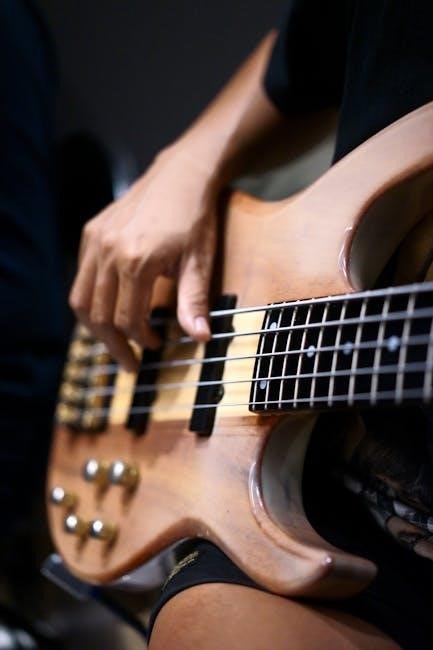
These PDFs demonstrate that chromatic notes aren’t random; they function as transitional elements, creating melodic movement between harmonically related pitches. Worksheets often include exercises specifically designed to practice chromatic approaches to target notes within chords.
Understanding the context is crucial – chromaticism should enhance, not obscure, the underlying harmony. The materials emphasize using chromaticism judiciously, ensuring it serves the musical phrase and doesn’t create unwanted dissonance. Mastering this technique elevates a basic walking bass line to a more sophisticated level.
Root Movement and Voice Leading
PDF resources on walking bass consistently highlight the importance of smooth root movement and effective voice leading. Materials, including those by John Patitucci, demonstrate how to create bass lines where each note logically connects to the next, minimizing large leaps.
These documents emphasize prioritizing chord tones – roots, thirds, fifths, and sevenths – to establish a strong harmonic foundation. Walking Bass PDFs often include exercises focusing on connecting these tones with minimal movement, creating a flowing, melodic line;
Good voice leading avoids awkward intervals and ensures a clear harmonic progression. The resources illustrate how to anticipate chord changes and prepare the ear for upcoming harmonies, resulting in a more musical and engaging bass line.

Building Your First Walking Bass Lines
Walking Bass PDFs begin with quarter note lines, utilizing the 1st and 3rd fingers, and applying chord tones in sequence for foundational practice.
Quarter Note Walking Bass Lines
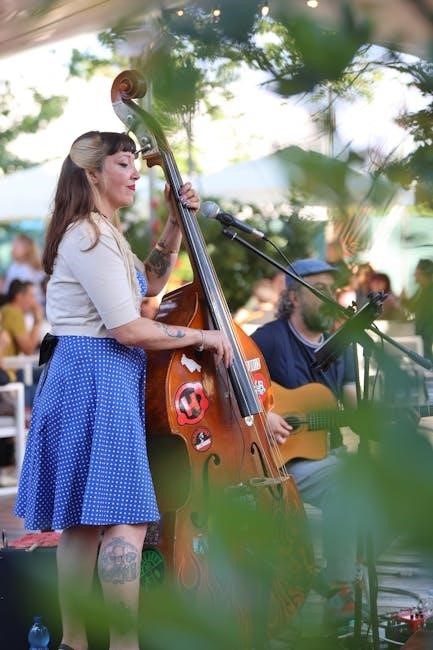
Walking bass instruction frequently emphasizes starting with simple quarter note lines as a core building block. Numerous PDF resources, including those by established bassists, advocate this approach for beginners. This method focuses on establishing a strong rhythmic foundation and harmonic awareness before introducing more complex rhythms or embellishments.
The simplicity of quarter notes allows students to concentrate on selecting appropriate chord tones and understanding root movement. Many walking bass PDF exercises specifically guide learners through constructing these lines, often suggesting utilizing the 1st and 3rd fingers for efficient execution. These initial lines serve as a canvas for later incorporating passing tones, approach notes, and rhythmic variations, ultimately leading to more sophisticated walking bass lines.
These foundational exercises, readily available in downloadable PDF formats, are crucial for developing a solid understanding of the underlying principles of walking bass.
Using the 1st and 3rd Fingers
Many walking bass PDF resources and instructional materials highlight the efficiency of utilizing the 1st and 3rd fingers – index and middle – for executing quarter note walking bass lines. This technique promotes smoother transitions between notes and minimizes unnecessary hand movement, crucial for maintaining a consistent and flowing bassline.
Beginner exercises found in these PDFs often specifically instruct players to prioritize these fingers, encouraging them to develop muscle memory for common intervals. This focused approach streamlines the learning process, allowing students to concentrate on harmonic choices rather than fretboard navigation.
While other fingers are certainly utilized in more advanced techniques, mastering the 1st and 3rd finger combination provides a solid foundation for building speed, accuracy, and overall control when constructing walking bass lines, as demonstrated in various downloadable PDF studies.
Applying Chord Tones in Sequence
Walking bass PDF resources consistently emphasize the importance of sequencing chord tones – root, 3rd, 5th, and 7th – to create compelling and harmonically sound basslines. These PDFs often present exercises that focus on outlining chord changes using these essential notes in a logical, stepwise fashion.
The core principle involves selecting chord tones that smoothly connect to the next chord in the progression, creating a sense of forward motion. Many PDF worksheets provide examples demonstrating how to prioritize strong chord tones, like the root and 3rd, for clarity and definition.
Advanced materials within these PDFs then introduce variations, showing how to incorporate passing tones and chromatic approaches between chord tones, adding color and sophistication to the walking bass line while still maintaining a strong harmonic foundation.

Advanced Walking Bass Techniques
Walking bass PDF materials detail techniques like ghost notes, passing tones, and approach notes, enhancing rhythmic variation and harmonic interest within lines.
Incorporating Passing Tones
Passing tones are crucial for smooth walking bass lines, bridging gaps between chord tones. Many walking bass PDF resources, like those by Mauro Battisti, dedicate sections to their effective use. These tones aren’t part of the underlying chord but create melodic interest as they ‘pass’ between harmonic notes.
Typically, passing tones are approached by step and left by step, ensuring a fluid connection. PDF exercises often demonstrate diatonic and chromatic passing tones, expanding your vocabulary. Utilizing them adds sophistication and avoids static, root-focused lines. Learning to identify strong chord tones and then strategically insert passing tones is a key skill developed through dedicated practice with these resources. Mastering this technique elevates your bass lines beyond basic functionality.
Utilizing Approach Notes
Approach notes, detailed in many walking bass PDF guides, add color and anticipation to your lines. These notes, typically a half-step or whole-step away from a target chord tone, create a sense of movement. Resources like those focusing on jazz improvisation often highlight their importance. They aren’t structurally essential but enhance the melodic contour.

PDF exercises frequently demonstrate both chromatic and diatonic approaches. Chromatic approaches, moving by half-steps, offer a stronger pull, while diatonic approaches, within the key, are more subtle. Effective use involves careful consideration of rhythm and voice leading. Learning to anticipate chord changes and strategically place approach notes is a skill honed through practice. These techniques, found within comprehensive walking bass materials, transform basic lines into compelling musical statements.
Ghost Notes and Rhythmic Variation
Many walking bass PDF resources delve into ghost notes – lightly played notes adding rhythmic nuance without strong articulation. They create a subtle “feel” and prevent lines from sounding robotic. These are often incorporated alongside standard quarter-note patterns, injecting a groove. PDF materials frequently showcase examples in blues and jazz contexts.
Beyond ghost notes, rhythmic variation is crucial. Explore syncopation, anticipating or delaying beats, to add interest. Some walking bass studies present exercises focusing on incorporating eighth-note triplets or rests. Mastering these techniques, as detailed in advanced PDF guides, elevates your playing. Experimenting with different rhythmic feels—swing, straight eighths—further expands your expressive palette, moving beyond predictable patterns and creating dynamic bass lines.

Resources for Learning Walking Bass
Numerous walking bass PDF resources exist, including materials by John Patitucci and Mauro Battisti, offering exercises and studies for all skill levels.
Popular Walking Bass PDF Resources (John Patitucci, Mauro Battisti)
John Patitucci’s materials are highly regarded, providing a deep dive into sophisticated walking bass concepts. His PDF often focuses on harmonic awareness and advanced techniques for improvisation. Conversely, Mauro Battisti’s resources, like “Walk With Me,” present a more structured approach, beginning with fundamental lines and gradually introducing complexity.
These PDFs cover essential elements such as the two-feel, Latin rhythms, and crucial walking bass vocabulary. Battisti’s series breaks down line construction, starting with basic principles. Many free resources also exist, like “Walking Bass 1,” offering introductory exercises. Furthermore, supplemental PDFs provide blues walking bass lines and worksheets for practicing chord tones and chromatic approaches, aiding in developing a strong foundation.
Blues Walking Bass Line Examples
Numerous PDF resources showcase blues walking bass lines, offering practical application of theoretical concepts. A common example utilizes a progression like G13, C9, G13, F7aug5, F13, E7aug5, demonstrating characteristic chord voicings and transitions. These lines frequently incorporate dominant 7th chords and augmented 5th intervals, creating a distinctly bluesy flavor.
Many downloadable PDFs present these lines in standard musical notation, allowing bassists to visually analyze the note choices and rhythmic patterns. Guitar-focused resources, often in tab format, also provide blues walking bass examples. Studying these examples helps internalize common blues progressions and develop improvisational skills within the genre. Practicing these lines builds fluency and a strong rhythmic feel essential for authentic blues performance.
Walking Bass Worksheets and Exercises
Several PDF worksheets are available to hone walking bass skills, focusing on practical application of chord tones and chromatic approaches. These exercises often present chord progressions and challenge bassists to create accompanying walking lines. They frequently begin with simpler exercises, emphasizing quarter-note patterns and root movement, then progress to more complex rhythmic variations and passing tones.
Many downloadable PDFs include pre-written bass lines for analysis, alongside blank spaces for students to compose their own. These worksheets often target specific techniques, like incorporating ghost notes or utilizing approach notes. Consistent practice with these materials builds a strong harmonic understanding and improves improvisational abilities. Utilizing these resources alongside instructional PDFs, like those by Patitucci and Battisti, accelerates learning.

Walking Bass in Different Genres
Walking bass adapts across genres; PDFs demonstrate its use in jazz standards, blues (with specific guitarra jazz tabs), and Latin rhythms, showcasing versatility.
Walking Bass in Jazz Standards
Walking bass is foundational to jazz, providing harmonic movement and rhythmic drive. Numerous PDF resources, including those by established players, detail its application within this genre. Learning materials often focus on constructing lines over common jazz chord progressions, emphasizing smooth voice leading and utilizing chord tones effectively.
These resources frequently present examples demonstrating how to navigate ii-V-I progressions, a cornerstone of jazz harmony. They also explore incorporating chromatic passing tones and approach notes to add color and interest to the bass lines. A key element highlighted in many PDF guides is the importance of understanding and applying swing feel, crucial for authentic jazz interpretation.
Furthermore, some materials offer transcriptions of walking bass lines from famous jazz recordings, allowing students to analyze and emulate the techniques of master bassists. The “Learn Walking Bass In Less Than 10 Minutes!” PDF specifically uses a jazz standard for instruction.
Walking Bass for Blues
Walking bass in blues differs from jazz, often employing a more direct and rhythmically grounded approach. Several PDF resources specifically address blues walking bass techniques, focusing on utilizing dominant chords and blues scales. These materials demonstrate how to create compelling bass lines over 12-bar blues progressions, a fundamental structure in the genre.
A readily available PDF document provides a complete blues walking bass line in musical notation, utilizing chords like G13, C9, and F7aug5. These resources emphasize incorporating characteristic blues inflections and rhythmic variations, such as shuffle rhythms and ghost notes, to enhance the groove. Guitarra jazz technique PDFs also cover walking bass for blues.
Many guides highlight the importance of using the 1st and 3rd fingers for efficient execution of quarter-note lines, a common technique in blues walking bass. Learning from these PDFs helps develop a solid foundation for improvising and comping in a blues context.
Walking Bass in Latin Rhythms
Walking bass applied to Latin rhythms requires adapting the traditional quarter-note approach to fit the characteristic syncopation. While dedicated PDF resources focusing solely on Latin walking bass are less prevalent, many comprehensive walking bass guides, like those by Mauro Battisti, dedicate sections to this application.

These materials demonstrate how to incorporate clave patterns and montunos into your bass lines, creating a driving and authentic Latin feel. Understanding the rhythmic nuances of genres like bossa nova, samba, and son is crucial. PDF exercises often focus on anticipating beats and utilizing passing tones to connect chord changes smoothly.
The “Beginning walking bass lines” PDF mentions Latin rhythms as part of its essential vocabulary. Mastering these techniques involves internalizing the rhythmic feel and adapting your fingerings to navigate the complex patterns effectively, enhancing your overall bass playing versatility.
Leave a Reply
You must be logged in to post a comment.